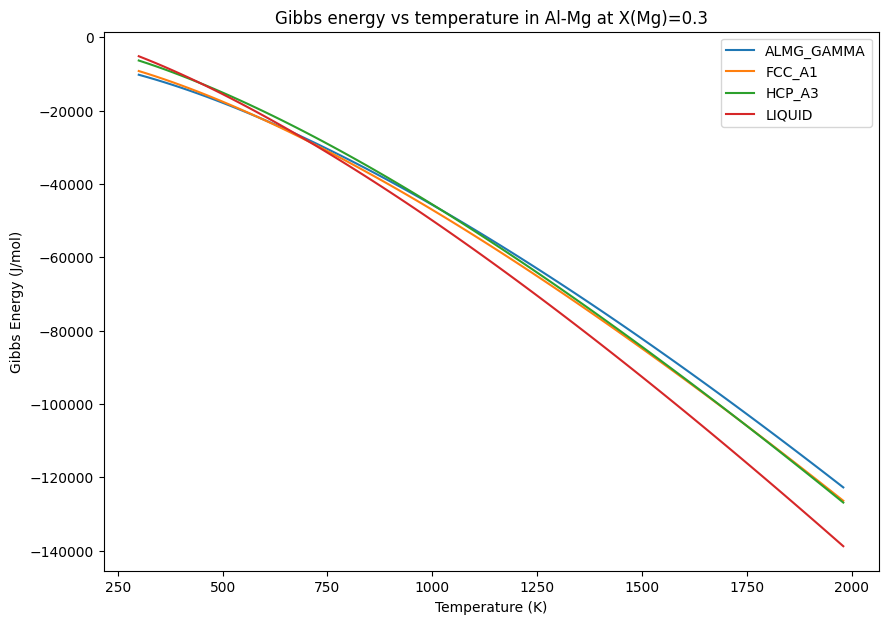
Gibbs Energy of Each Phase at Fixed Composition
It can be useful to compare the Gibbs energies of individual phases at a fixed alloy composition across temperature, for example to understand which phase becomes stable when, or to inspect the relative metastability of competing phases.
This example shows how to compute \(G_M(T)\) for each phase in the Al-Mg system at a fixed Mg mole fraction by constructing one Workspace per phase.
[1]:
import matplotlib.pyplot as plt
from pycalphad import Database, Workspace, variables as v
Set up the database, components, and a temperature sweep at fixed composition X(Mg) = 0.3.
[2]:
dbf = Database('Al-Mg_Zhong.tdb')
components = ['AL', 'MG', 'VA']
mg_composition = 0.3  # mole fraction

conditions = {
    v.N: 1,
    v.P: 1e5,
    v.T: (300, 2000, 20),
    v.X('MG'): mg_composition,
}
Loop over the phases in the database. For each phase, build a Workspace restricted to that single phase so the equilibrium calculation cannot pick a different phase. Plot the Gibbs energy as a function of temperature.
Stoichiometric phases (e.g. ALMG_BETA and ALMG_EPSILON) only exist at their fixed composition, so they have no valid solution at X(Mg) = 0.3 and are skipped automatically (their curves are all NaN).
[3]:
import numpy as np

fig, ax = plt.subplots(figsize=(10, 7), dpi=100)
for phase_name in sorted(dbf.phases.keys()):
    wks = Workspace(dbf, components, [phase_name], conditions)
    T = wks.get(v.T)
    GM = wks.get('GM')
    if np.all(np.isnan(GM)):
        print(f'Skipping {phase_name}: no valid solution at X(Mg)={mg_composition}')
        continue
    ax.plot(T, GM, label=phase_name)

ax.set_title(f'Gibbs energy vs temperature in Al-Mg at X(Mg)={mg_composition}')
ax.set_xlabel('Temperature (K)')
ax.set_ylabel('Gibbs Energy (J/mol)')
ax.legend(loc='best')
Skipping ALMG_BETA: no valid solution at X(Mg)=0.3
Skipping ALMG_EPSILON: no valid solution at X(Mg)=0.3
[3]:
<matplotlib.legend.Legend at 0x11ae69e80>